
Booking a Community Hall: A Shared Calendar Instead of a Notebook
The booking notebook lived in the president's cupboard. Since it was replaced by a shared calendar, the hall is used twice as often — and no one calls on Saturday morning anymore.
Marc, 63 ans — trésorier d'une association de village
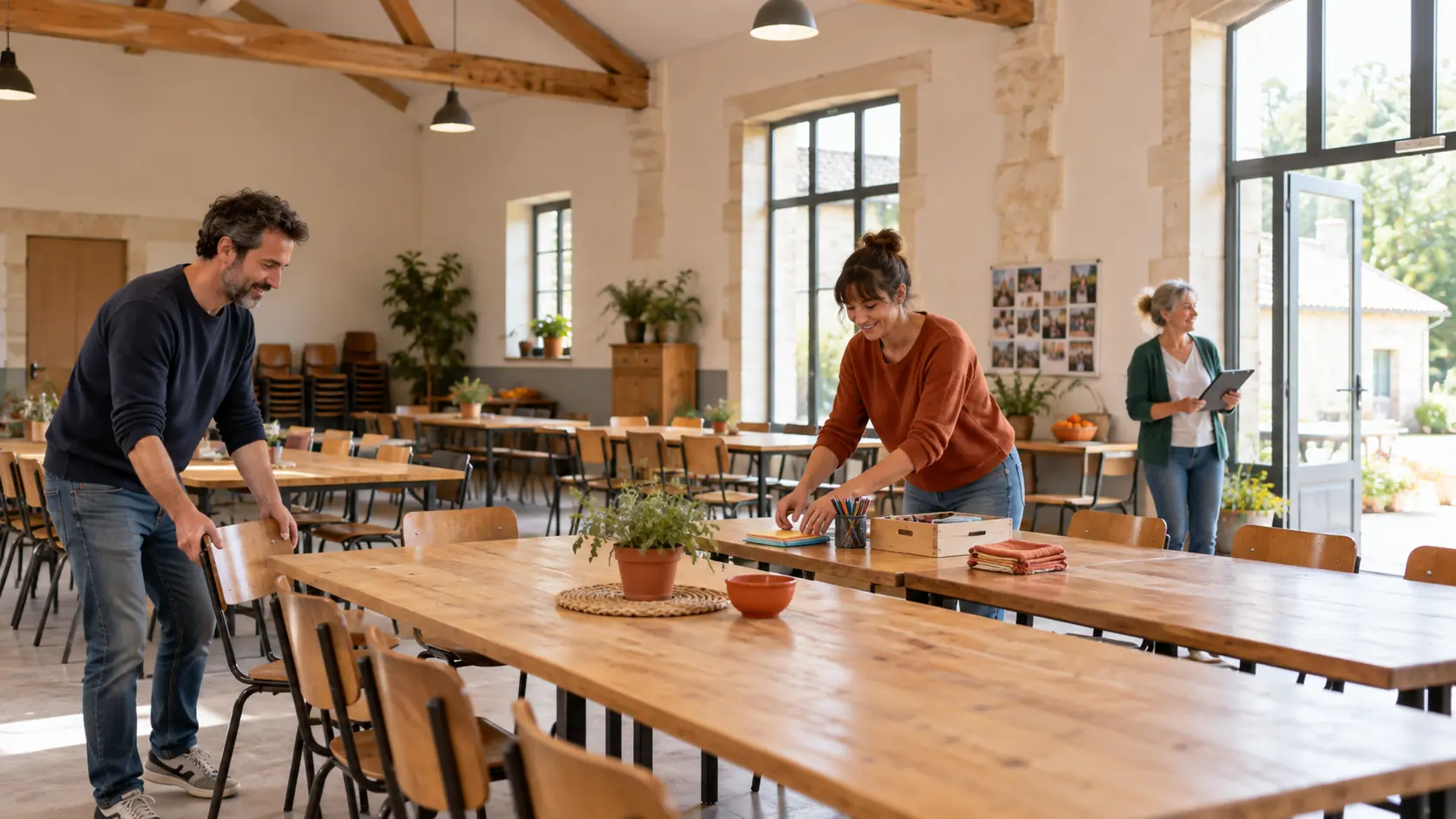
The association runs an 80-seat hall in a village in the Ain. It's lent for free to members for birthdays, family meals, and meetings.
The Notebook and Its Limits
For fifteen years, bookings went through a notebook kept by the president. "You had to call him, he'd check, he'd write it down. If he was away, you waited."
- No one else knew the availability.
- Two bookings for the same Saturday happened three times in five years.
- The notebook was lost once, and found again a month later.
- The president got calls on weekends.
"It wasn't unmanageable. It was just always on the same person's shoulders."
What They Set Up
The association created a Klub bringing together its members who are up to date on dues. The hall is listed there as a full-fledged space, with its photos, capacity, and equipment — tables, chairs, kitchen, sound system — and its rules of use.
Everyone Sees and Books
A member checks the calendar, sees which Saturdays are free, and books. The board receives the request and approves it. "We kept the approval step: it's a communal hall, we need to know who's using it. But we no longer have to go looking for the information, it's already there."
The Rules Are Written Down Once
The Sunday deadline, waste sorting, the condition the kitchen should be left in, the number of tables available: it's all on the space's listing. "Before, we repeated the same instructions every time we lent it out, and they'd get forgotten."
What Changed
The hall is now used about twice as often as before. The president estimates he's gotten back "a good hour a week." And members book more readily: seeing an open slot gives people the idea to organize something, whereas before you had to already have the plan in mind to pick up the phone.
Who This Speaks To
This applies to any space shared by a group: a community hall, an association's premises, a shared workshop, a company retreat, a neighborhood center. What these spaces have in common is that they're underused not for lack of demand, but because availability is visible to only one person.